
‘Lanterns’ Team Explains That Heartbreaking Change to Hal Jordan’s Origin Story
Note: This story contains spoilers from “Lanterns” Episode 7.
With only one episode left on the clock, “Lanterns” is barreling toward its grand finale. This week came with a major change to Hal Jordan’s origin story that proved the HBO series still has some tricks up its sleeve.
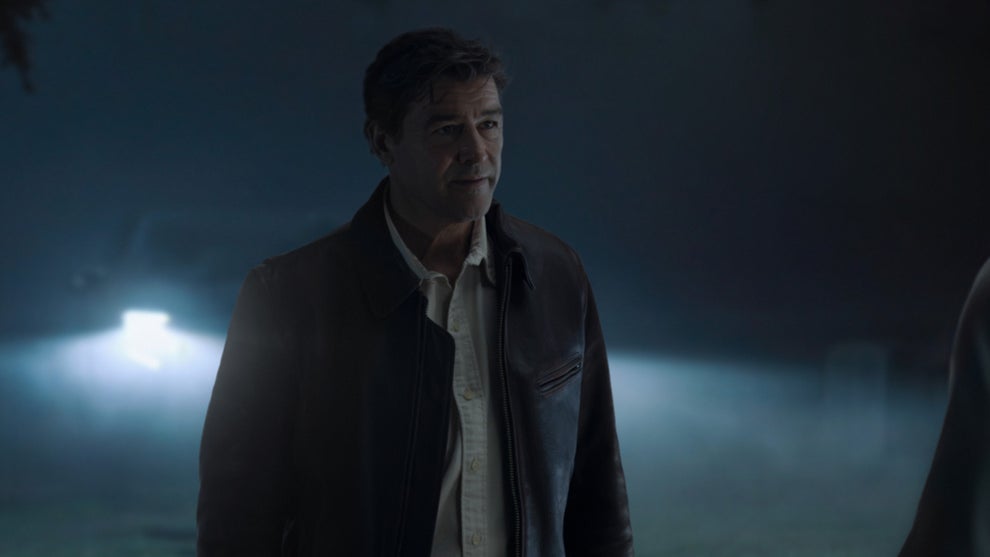
With Hal (seemingly) dead and gone, Episode 6 reintroduced the Halogram, a younger version of the Green Lantern veteran played by Kyle Chandler. Through this circa 2006 construct, plus some key flashbacks to Hal’s youth, John Stewart (Aaron Pierre) and fans alike got a glimpse into the tragedy that made the senior Lantern the man he was in 2016.
“It’s more to build into the character. It’s more history. It’s more darkness. It’s more pathology of the character. There’s a lot going on with these two dudes,” Chandler told TheWrap. “As I’ve said before, and (Aaron) can speak for himself, but Hal had a pretty rough coming up in the world, all the stuff that happened, getting the ring, knowing about my family’s past, but look at his childhood! *laughs* I mean, come on!”
“Lanterns” threw audiences a curveball by revealing the truth behind the episode’s namesake: the Jordan Boys Legacy. Hal shared that his father, Martin Jordan, didn’t simply die in a test crash accident, as has long been part of Green Lantern’s comic book origin. Instead, Martin (created by Christopher Priest and Mark Bright in 1989’s “Green Lantern: Emerald Dawn #1”) took his own life, crashing his plane on purpose.
“My old man, he was convinced we’d be better off without him. Said he had that pain his whole life. Said it was getting worse. He couldn’t hide it,” the Halogram tells John, recalling a note his father left him to open after his death. “Couldn’t bear to let us see it. Couldn’t bear to let us see him. He told me all this because my grandfather left it in a note to him. He had the same pain, passed down generation to generation, father to son. They called it the Jordan Boys Legacy. Man, I’m not fearless because I’m brave. I’m fearless because I’m broken.”
According to “Lanterns” showrunner and co-creator Chris Mundy, the Jordan Boys Legacy twist came about just as shooting was about to start, giving Chandler enough time to work this turmoil into his character from the beginning.
“Before we rolled camera, he knew the pain his character held so that he could incorporate that however he does, in his sort of brilliant way, into the performance he was giving.”
It’s a sobering moment, with the Halogram soon revealing to John that he fears the real Hal Jordan may have taken his own life, carrying on the Jordan Boys Legacy. It’s also the kind of moment that let Chandler know that “Lanterns” was “a different type of superhero story” — just like John Stewart’s own haunting origin was.
“When you’re playing around with the canon, you have to treat it like you’re handling plutonium,” “Lanterns” co-creator Damon Lindelof told TheWrap.
“But at the same time, there’s kind of no fun and creativity and originality in that, so you simultaneously sort of have to start to kind of iterate.”
Though Martin Jordan’s death didn’t come about until decades after Hal’s debut, it has since become a core aspect of that hero’s origin and history. Lindeolf co-wrote “The Jordan Boys Legacy” alongside veteran comic book writer and “Lanterns” co-creator Tom King. Lindelof said the pair and their writers’ room worked to figure out a central conundrum in adapting characters like Hal and John who have decades of established lore: “How do I expand upon the existing canon without completely and totally violating it?”
“Ultimately, it’s sort of like, what is the basis of the character? Is Batman still Batman if his parents aren’t killed? Is Superman still Superman if there’s a Krypton? Is Hal Jordan still Hal Jordan if his dad didn’t die in a test flight?” Lindelof wondered. “Probably not, but then, ‘Can you recontextualize the death,’ is the way that we approached it.”
Writers have taken such swings before and succeeded. While Lindelof said it would be tough to sell a version of Batman whose parents weren’t killed, Scott Snyder and Nick Dragotta’s current “Absolute Batman” comic explores an alternate version of Bruce Wayne whose mother never died and who doesn’t come from wealth. These ideas, and several others featured in the series, would be targets for endless hate from DC die-hards if executed poorly. Instead, that series has been met with massive sales and critical acclaim, with a TV adaptation already on the way.
For the “Lanterns” writers’ room, interrogating Hal’s fearlessness (or lack thereof) was key to carving out their own story — making their show a similar success.
“Are there different contextual frameworks for fearlessness that are more relatable to the time that we live in now? That is to say, do I actually know anybody who’s presenting as fearless, and what’s at the heart of that fearlessness? … We would say to Tom (King), ‘Is there anything in the canon that would suggest that Hal’s dad dying wasn’t an accident?’” Lindelof said. “Then he would reference something. So you find these little kind of oral arguments for what I think is the worst thing that you can possibly do in these spaces, which is violations of the canon.”
“Lanterns” airs Sundays on HBO and HBO Max.
Share this:

Discover more from Topcitytune Media
Subscribe to get the latest posts sent to your email.