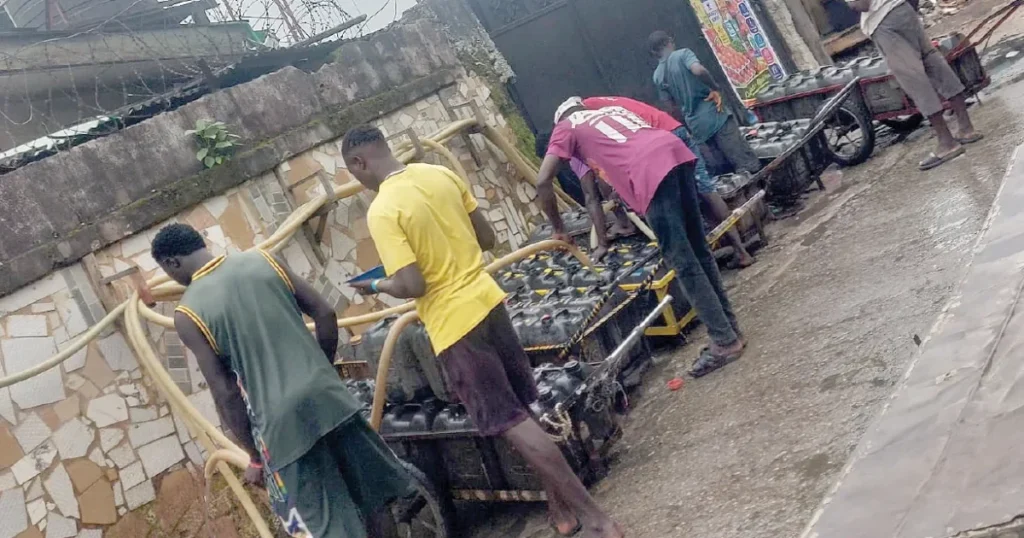
Getting clean water into homes across Lagos has turned into an expensive daily hurdle for millions of people. With public taps dry across wide parts of the metropolis, households are turning to informal water vendors, commonly called meruwa, to bathe, cook, and wash.
An investigation by Punch reveals that low-income families are parting with over N45,000 every month just to buy domestic water. The situation stems from the limited reach of the Lagos State Water Corporation, which currently provides water to only 1.65 million residents. This coverage accounts for just about 8.3 per cent of the state's population of more than 20 million people.
In areas like Ogba, situated in the Ikeja Local Government Area, residents must wake up before dawn to buy supplies. One food seller and mother of three, identified as Mama Farida, explained that she buys 25 jerry cans across two and a half vendor carts every day for N3,500. On weekends, her needs rise, pushing her weekly bill to N24,500 and over N105,000 monthly.
That monthly spending easily surpasses Nigeria's national minimum wage of N70,000. To make matters harder, the cart water is not fit for drinking, forcing families to spend extra cash on packaged sachet water.
Unstable electricity supply makes the problem even worse. When there is no light to pump water from boreholes, vendor rates climb rapidly. In Ogba, a single cart holding 10 jerry cans can shoot up from regular prices to as high as N4,000.
Residents recall that vendor charges used to be as low as N300 per cart before climbing through N500, N700, and N1,500 following fuel subsidy removal and escalating power failures. After five years in her neighbourhood, Mama Farida noted she has never seen public tap water run, leaving her at the mercy of private sellers.
Guidelines from the United Nations state that water costs ought not to exceed 3 per cent of a household's income, with every person entitled to between 50 and 100 litres daily. For now, affected Lagosians are urging the state government to fix its public network so clean water can reach ordinary homes directly.