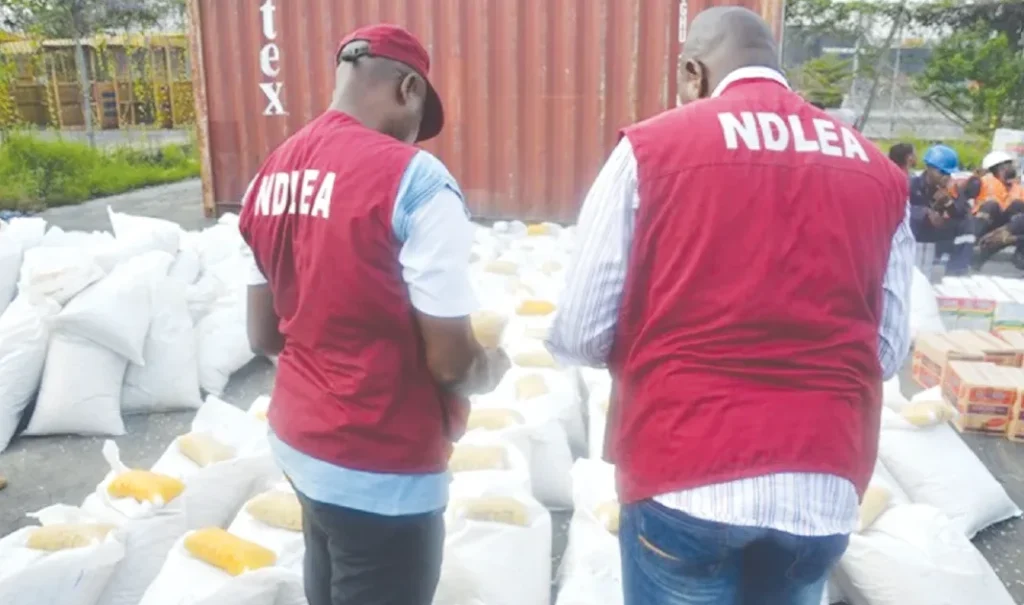
The National Drug Law Enforcement Agency has expressed strong concern over the growing participation of foreign citizens in cross-border narcotics trafficking through Nigerian borders. Officials revealed that three South African nationals were recently taken into custody after being caught with large shipments of heroin, cocaine, and synthetic cannabis, commonly known as Loud.
Speaking during a joint security briefing in Abuja, the agency’s Assistant Director of Media and Advocacy, Francis Okogun, confirmed that the suspects are believed to be couriers for global syndicates, according to Punch. Okogun explained that foreign operatives are increasingly moving illicit consignments into Nigeria or using the country as a transit corridor to reach destinations worldwide.
He noted that operatives are carrying out careful inquiries to uncover the intended locations of the seized narcotics and unmask the cartels sponsoring the operations. Because couriers typically refuse to reveal their handlers, Okogun stressed that investigators are working thoroughly to map out the networks backing these shipments.
The briefing follows high-profile airport interceptions across the country involving South African citizens. In October 2026, NDLEA officers at Port Harcourt International Airport held Gebashe Sithandiwe Jessie for allegedly attempting to bring in 32.74 kilograms of synthetic cannabis, branded as Thai Loud. Months earlier, in July 2026, 38-year-old Will Jessica Ann was arrested at the Nnamdi Azikiwe International Airport in Abuja after officials discovered 5.75 kilograms of heroin hidden in 14 blocks inside her luggage following an inbound flight from Doha.
Alongside the airport interceptions, NDLEA Chairman and Chief Executive Officer Brig. Gen. Buba Marwa declared a renewed offensive against narcotics abuse and trafficking during a stakeholder meeting in Benin, Edo State. Marwa told community leaders, military and police personnel, civil society representatives, and youth corps members that law enforcement alone cannot solve the problem without broader community vigilance.
Marwa announced plans to consult leadership bodies from the Christian Association of Nigeria and the Islamic council in Benin, urging religious leaders, teachers, and parents to take proactive roles in educating and protecting youths from illegal substances.